Analog Tricks with Digital Media
The Soroptimist Club of Wiesbaden is making a film project for girls possible with artist Ferri Caicedo
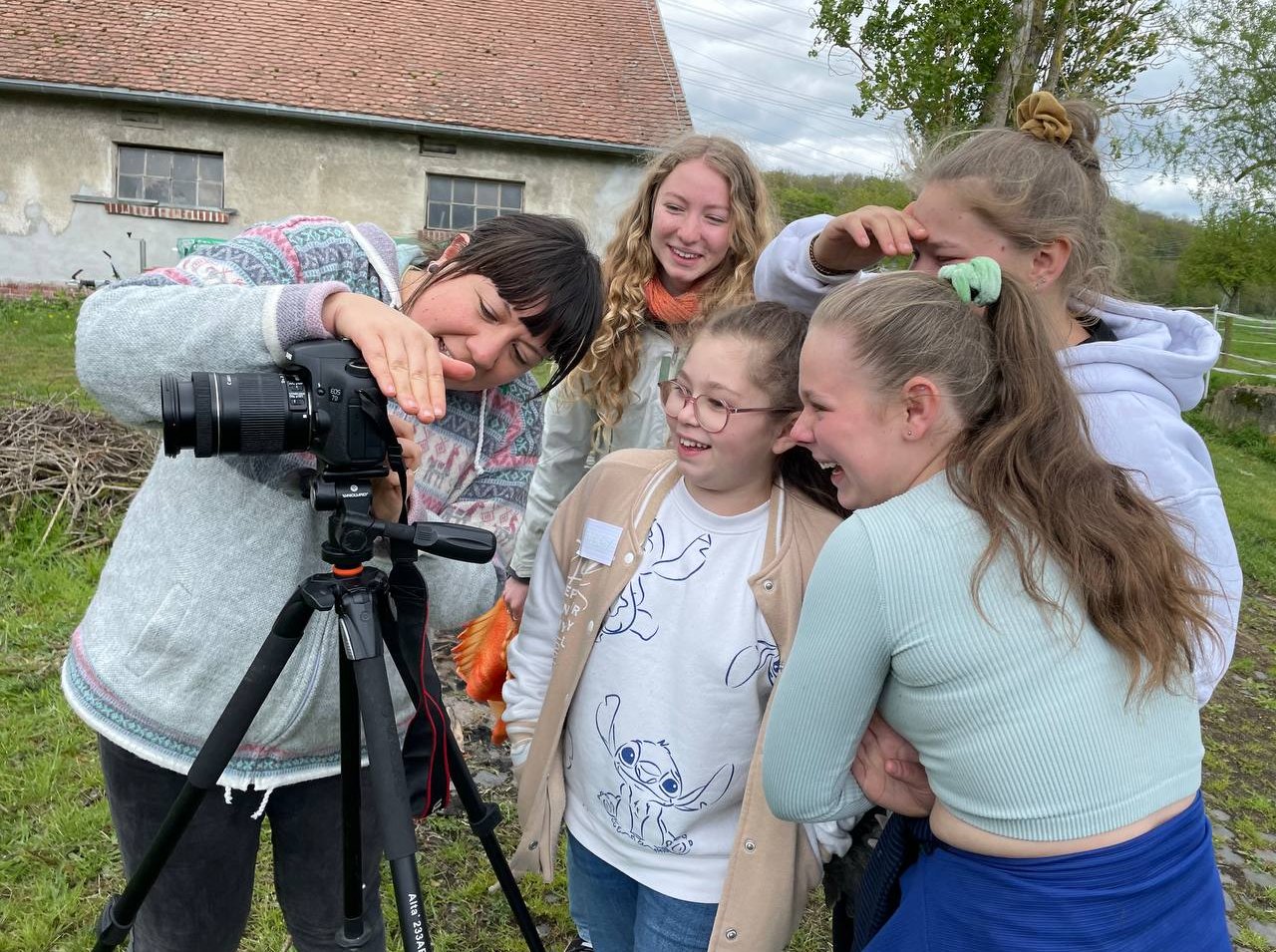
Over the course of two days, there were no limits to the imagination of the participating students. In an animation workshop with Ferri Caicedo, anything was possible: from monsters climbing over walls to dancing horses. Right from the start, the girls in grades 3 through 9 learned how the human brain constructs coherent movement from a rapid sequence of images and how to make people fly in a film—even without digital editing. Of course, they had to try this out right away—until everyone was almost out of breath from all the jumping in the air.
The students at the school for children of professional travelers then showed great attention to detail in creating their own films. Through the lenses of their tablets, colorful worlds and creatures made of fabric, wire, wood, or modeling clay came to life. “And I directed it myself!” one student proudly told her teacher after the workshop.
Ferri Caicedo, an artist originally from Ecuador, works with the analog stop-motion film technique herself. During the workshop, she also showed the students her latest work, “Wind Whisperer,” for which she has received a total of eight awards at international film festivals, including the DEFA Promotion Prize at the Dresden Film Festival. During the breaks in the workshop, the students asked many questions about Caicedo’s creative process and her daily life as an artist.
All of the students’ films will be screened for an audience at the summer festival of the School for Children of Business Travelers in June. This STEM project* was made possible by a generous donation from the Soroptimist Club of Wiesbaden, which aims to foster girls’ interest in technical and scientific fields. Two years earlier, the club had already funded a drumming workshop that had a lasting impact on the young students’ enthusiasm for STEM subjects. One participant from the previous workshop even traveled all the way from Ludwigshafen to Giessen specifically to take part in such a project again—and she was not disappointed. “This was a wonderfully creative project for our students,” said Torsten Rudloff, principal of the school for children of traveling professionals. “We are grateful for the generous donation.”
*STEM projects are initiatives or activities focused on the fields of science, technology, engineering, and mathematics. Their goal is to foster interest and skills in these subject areas. These projects can be carried out by schools, universities, companies, or nonprofit organizations and range from educational programs to research projects and competitions.
EVIM Evangelischer Verein für Innere Mission in Nassau
Fundraising
Auguste-Viktoria-Str. 16
65185 Wiesbaden
Donation account
Bank für Sozialwirtschaft
IBAN: DE02 3702 0500 0004 6010 00
BIC: BFSWDE33XXX
or donate online here

Dieter Nühlen
Referent Fundraising